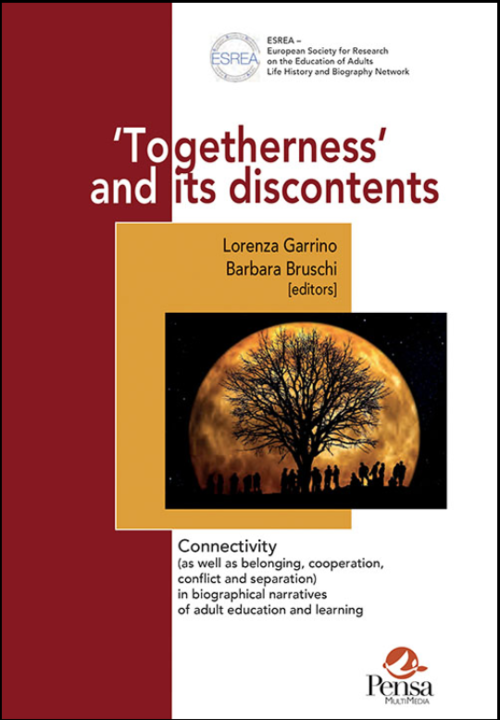
Livre de Lorenza Garrino et Barbara Brusch
In an era of new racisms, of walls that rise in the name of indifference and hatred, of seas where the desperate lives of men and women are lost hosting a conference whose title starts with the word “Together-ness” is a privilege and at the same time a sign of hope. It is a privile-ge because it means being able to bring together to our country an international community that, for more than 25 years, has put peo-ple and their stories at the centre of its research and training activi-ties. Humanity has an urgent need to find interests that unite rather than divide, indeed interests that orient the different forms of indivi-dual and social actions in the view of a common well-being. Howe-ver, the title of this conference also includes a second key term, “discontents”. Discontents is seen in its necessary and fundamental dimension of human existence and complex organizational systems This was the meaning of the Turin conference in which, for three whole days: scholars, operators, students and researchers tried to give answers to questions such as: What kind of learning emerges from the experiences of connectedness? Can life-based or narrative resear-ch itself enhance togetherness, and if so how, in which conditions and with what effects? Can togetherness become a delusion, a mysti-fication, a prison for the mind, or an obstacle in a world that celebra-tes individualism? This volume collects the numerous answers that arose during the working days and offers a plurality of looks as well as a variety of proposals that do not claim to be exhaustive, but offer themselves as starting points for other “conversations”. The variety of themes and approaches presented in this volume allows us to represent the togetherness as a kind of kaleidoscope: the elements are always the same, but depending on the rotation and position the shapes vary by proposing different figures

 SmallStories















 ComprendreTravailEducatifDiversite